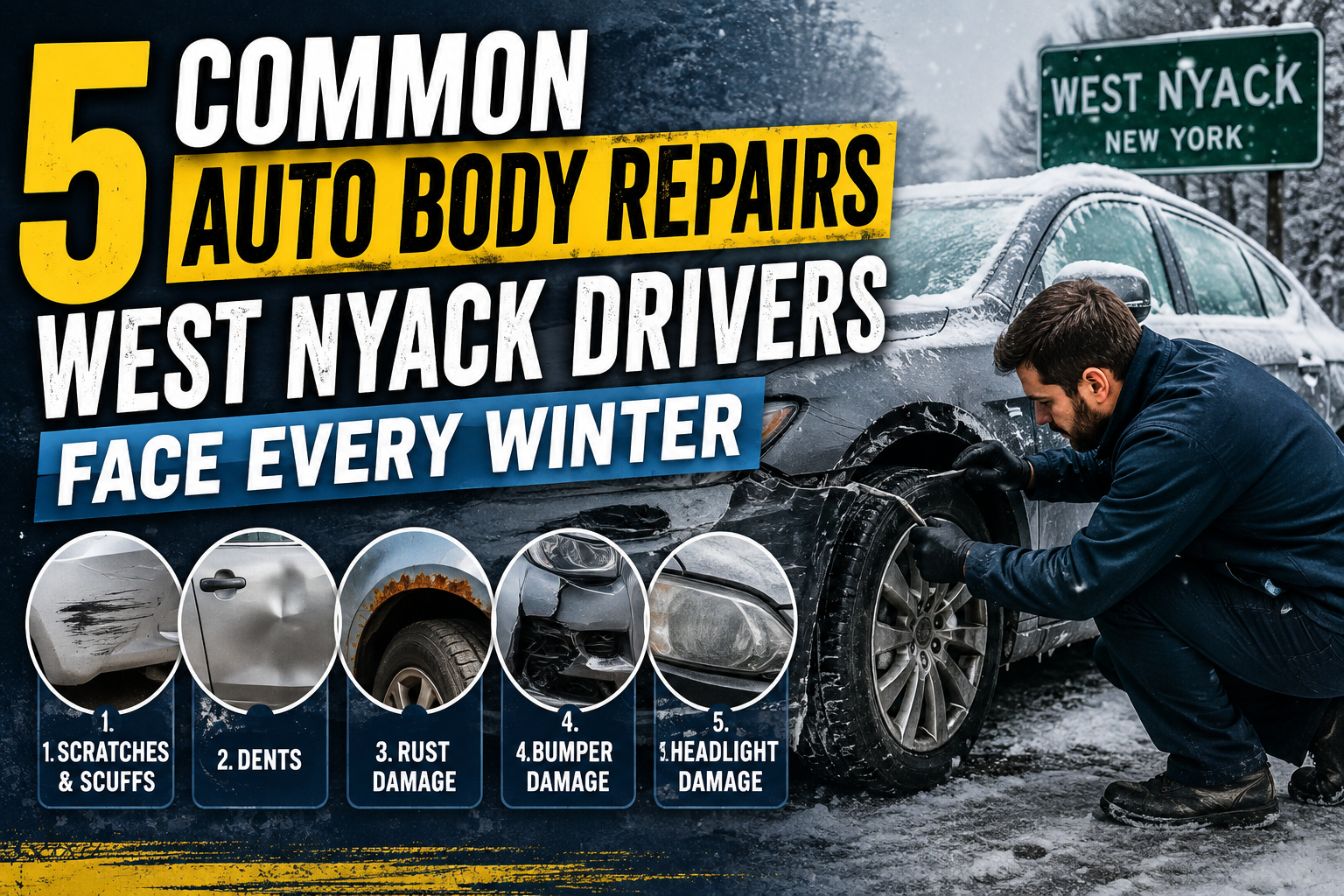
Most West Nyack drivers treat winter body damage as a series of separate, unlucky events. A chip here. Some surface rust there. A scraped bumper after a February parking lot. What they rarely see is the sequence connecting all of it. Winter damage almost never arrives in isolation. It compounds. One problem creates the exact conditions for the next, and by spring, what started as a paint chip in October has become a structural or corrosion repair with a cost to match. Drivers who visit any reputable auto body repair shop in New York after spring thaw are often shocked by how far the damage traveled from a single starting point. Understanding the chain is how you stop it.
Why West Nyack Winters Are Harder on Your Car Than You Think
Rockland County sits in a freeze-thaw corridor that cycles more aggressively than much of the surrounding region. Temperatures cross the freezing threshold multiple times within a single week, and Route 59’s commercial traffic volume means municipal salting runs consistently from November through March.
That combination — repeated thermal cycling plus sustained salt exposure — turns minor, manageable damage into compounding structural deterioration. The misconception worth correcting is that only collision victims visit a collision repair shop in New York in winter. Road-condition damage is equally destructive, and far more gradual. That’s what makes it dangerous.
The Chain Begins — Stone Chips and Paint Breaks That Open the Door to Rust
Stone chips are the trigger event. On salted roads, plow activity launches road debris at speeds and trajectories that summer driving doesn’t replicate. A chip that stays superficial in July becomes a different problem in January.
The core misconception: chips are cosmetic. They are not. Once a chip breaks through the paint film to bare metal, oxidation begins within 48 to 72 hours under cold, wet conditions. The damage stays invisible for four to six weeks — exactly the window when most drivers lose the chance to address it cheaply.
At Stage 1, a chip fill or localized paint repair is fast and low-cost. Left through a full Rockland County winter, that same chip becomes the entry point for rust that no longer qualifies as cosmetic.
What “Surface Rust” Actually Means for Your Panel Integrity
Rust progresses in three stages: surface oxidation, scale rust, and penetrating rust. Most drivers — and most general auto articles — treat “surface rust” as a catch-all. It is not.
Surface oxidation is reversible. Scale rust has already begun consuming the metal substrate. Penetrating rust has compromised the panel itself.
Freeze-thaw cycles accelerate stage transitions. Water infiltrates micro-cracks in the oxidation layer and expands with each cycle. A chip at Stage 1 in October can reach Stage 2 by January without any additional road contact. Stage 2 repair costs are meaningfully higher. Stage 3 involves panel replacement.
Seal Failure, Moisture Intrusion, and the Hidden Damage Drivers Never See
Once a paint chip or hairline fracture compromises the film near a panel edge, seam, or trim boundary, moisture enters enclosed cavities. What follows is damage most drivers never see until it’s advanced.
The failure points most vulnerable in West Nyack winters are door seam caulking, rocker panel edges, and windshield perimeter seals. Once moisture enters a panel cavity, it does not drain. It pools, corrodes from the inside out, and stays invisible until bubbling appears on the paint surface — at which point the damage beneath is already structural.
Seal failure does not require a collision. Thermal cycling alone — sealant contracting and micro-cracking across two or three winters — is sufficient to open these pathways. A qualified auto body repair shop in New York will assess seal integrity as part of any winter inspection. Most general service centers do not.
Resealing compromised edges before moisture establishes itself costs a fraction of what inner-panel restoration requires at Stage 3.
The Rocker Panel Problem West Nyack Drivers Underestimate
Rocker panels are the lowest, most road-exposed structural element on most passenger vehicles — and the least inspected. Their geometry makes them the primary accumulation point for salt-laden slush: low profile, horizontal, fully road-facing.
The damage pathway is consistent. Slush packs into the inner lip. Trapped moisture accelerates internal corrosion. Left unaddressed, that corrosion compromises the structural member, affects door alignment, and reduces the side-impact protection the rocker panel is built to provide.
This failure mode rarely appears in competitor content. It is one of the most common winter repair jobs any collision repair shop in New York handles from January through April.
From Cosmetic to Structural — When Winter Damage Crosses the Line
There is a point in the compounding sequence where damage stops being a body shop issue and begins implicating structural integrity or safety systems. Three scenarios drive this most often in Rockland County:
- Pothole strikes on Route 59 and county roads post-freeze deform subframe mounting points in ways that don’t present as visible body damage. The misalignment is structural, not aesthetic.
- Deer strikes are statistically elevated from November through January in this region. Front-end contact frequently displaces radar and camera housings, triggering ADAS calibration requirements alongside bodywork.
- Ice-related parking lot contact shifts bumper fascias and can misalign sensor housings without cracking them. A fascia that looks repaired may still house a miscalibrated forward collision sensor.
A vehicle that passes a visual inspection may still carry miscalibrated ADAS systems. Proper assessment requires a shop with structural diagnostic and ADAS calibration capability — not one limited to cosmetic repair.
Catching the Chain Early — What a Winter Body Inspection Actually Covers
A professional winter auto body inspection is not a mechanical service check. Most drivers don’t know these are separate diagnostic processes.
A proper body inspection evaluates:
- Paint film integrity — identifying chips, micro-fractures, and adhesion failure before oxidation establishes
- Seal condition — checking door seams, windshield perimeters, and rocker edges for thermal contraction damage
- Undercarriage corrosion staging — identifying where rust sits in its progression and whether it remains reversible
- Panel gap consistency — detecting subframe or structural shift that surface inspection misses
- Sensor housing alignment — confirming ADAS components remain correctly positioned after road contact
Spectrum Auto’s inspection process identifies exactly where in the compounding chain your vehicle sits. Drivers in West Nyack who haven’t had a body inspection since last winter are not pre-chain. They are mid-chain. Catching damage now versus discovering it in April carries a significant cost difference.
Trust Spectrum Auto Inc. to Break the Winter Damage Chain
Winter doesn’t damage vehicles all at once. It works gradually, using each unaddressed problem to create the next. Spectrum Auto Inc. has built its reputation across West Nyack and Rockland County by treating auto body repair as a diagnostic process, not just a cosmetic one. Their team identifies where in the compounding sequence your vehicle sits and intervenes before minor damage becomes structural. As a trusted auto body repair shop in New York, Spectrum Auto combines collision repair expertise, ADAS calibration capability, and genuine local knowledge to protect your vehicle through every season. Don’t wait until April to find out what January started.
Frequently Asked Questions
- Can a small paint chip really lead to structural rust over a single winter?
Yes. Once a chip exposes bare metal, oxidation begins within 48 to 72 hours under cold, wet conditions. Freeze-thaw cycles force water into the breach repeatedly, accelerating rust from surface oxidation to scale rust faster than most drivers expect. A single Rockland County winter is enough time for Stage 1 damage to advance if left unaddressed.
- How do I know if my vehicle’s seal failure is causing internal panel damage?
You likely won’t — not visually. Internal panel corrosion often stays kind of, out of sight until you see paint bubbling starting on the surface and then you realize the damage is already well advanced. The thing is, the only dependable way to notice it early is really a professional body inspection, where they check things like seam caulking, the rocker edges, and even the windshield perimeter integrity, before moisture manages to settle inside the cavity.
- Is ADAS recalibration really necessary after a minor winter bumper repair?
Yes, in most cases. Radar and camera housings sit within or directly behind bumper fascias. Contact that doesn’t visibly crack the fascia can still shift sensor positioning enough to affect system accuracy. A shop equipped for ADAS diagnostics will confirm alignment post-repair. A shop without that capability cannot.
- How is a winter auto body inspection different from my regular mechanical service?
They assess entirely different systems. A mechanical service checks fluids, filters, brakes, and drivetrain components. A winter body inspection evaluates paint film integrity, seal condition, undercarriage corrosion staging, panel gap consistency, and sensor housing alignment. Most general service centers do not perform body inspections as part of routine maintenance. They require dedicated collision repair expertise.