

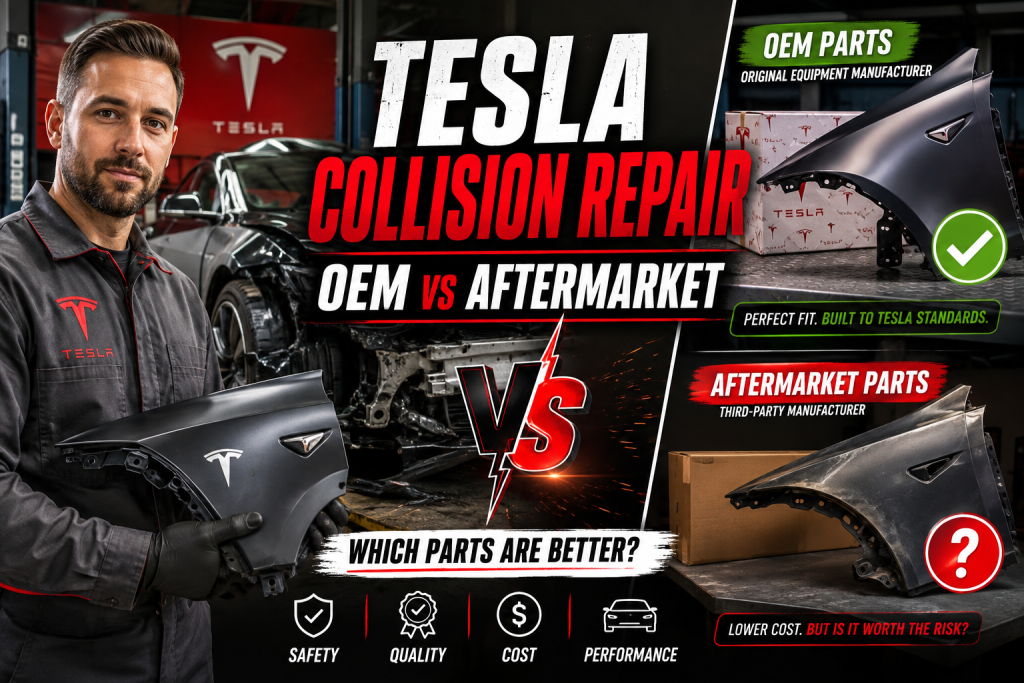
Most Tesla owners walk away from a collision repair thinking the hardest part is behind them. The car looks right. The insurance claim closed. What they don’t realize is that the repair decision they just made — which parts were used and who did the work — has been encoded into their vehicle’s permanent record. Tesla’s ecosystem doesn’t forget. When resale time comes, that record surfaces in ways that cost owners thousands. Choosing a Tesla-certified collision center before authorizing any repair isn’t a premium upgrade. It’s the only way to protect what your vehicle is actually worth.
Tesla’s Repair Ecosystem Is Not Like Any Other Automaker’s
Traditional collision repair works at a general body shop because most vehicles treat hardware and software as separate systems. Tesla doesn’t. Every Model 3, Model Y, Model S, and Model X is a software-defined vehicle where physical components and the onboard computer operate as one integrated system.
When a repair happens, Tesla’s ecosystem logs it. The shop’s certification status, the parts installed, the calibrations performed — all of it is timestamped and recorded. This isn’t a warranty tracking tool. It’s a permanent vehicle history that exists entirely outside of Carfax or any third-party report.
The misconception that collision repair is purely cosmetic — something that affects appearance but not value — is one of the most expensive assumptions a Tesla owner can make. The moment aftermarket parts enter the equation, or a non-certified shop performs the work, that event becomes part of the vehicle’s record. It doesn’t announce itself at the time. It shows up later, at the worst possible moment.
What Tesla’s Proprietary Service Records Actually Track
Tesla’s internal vehicle history captures far more than most owners expect. Part origin — OEM or non-OEM — is logged alongside the certification status of the shop that performed the work. Post-repair calibration outcomes are recorded. Structural repair flags attach to the vehicle identification number and stay there permanently.
This data doesn’t appear in the owner’s Tesla app. It isn’t visible during normal operation. It surfaces during CPO inspections, third-party pre-purchase diagnostics, and Tesla’s own resale evaluations — exactly when it carries the most financial weight.
A clean Carfax report does not equal a clean Tesla history. Carfax captures title events, reported accidents, and odometer readings. Tesla’s internal record captures what happened inside the repair — a separate layer of vehicle data that most sellers don’t know exists until it hits their offer.
One more risk receives almost no attention: over-the-air software updates. Vehicles with sensor-adjacent components outside OEM specification have produced calibration error flags post-update — even when the car operated normally before the update was pushed.
The CPO Eligibility Problem
Tesla’s Certified Pre-Owned program requires vehicles to pass internal certification standards before qualifying. Aftermarket structural or sensor-adjacent repairs can disqualify a vehicle outright — not because the car looks damaged, but because the repair record fails Tesla’s requirements.
Owners who plan to sell back to Tesla or through Tesla-affiliated resellers hit this filter at the valuation step. Most discover the disqualification only after pricing their vehicle on mileage and condition alone. By that point, the decision that caused it was made months or years earlier, at the body shop.
How Aftermarket Parts Quietly Reduce Your Tesla’s Resale Value
The financial damage from an aftermarket repair doesn’t always look like damage. It looks like a lower offer, a longer time on market, or a private buyer who walks after a pre-purchase inspection. Two resale scenarios carry the highest exposure.
Selling through Tesla or a Tesla-affiliated CPO channel triggers internal record reviews. Aftermarket parts and non-certified repairs produce automatic valuation adjustments — or outright disqualification — before price negotiation begins.
Selling privately or through a third-party dealership used to carry less risk. That’s no longer true. Tools like Scan My Tesla and third-party EV diagnostic platforms now surface repair anomalies that were invisible five years ago. Sophisticated buyers and used EV dealers run these checks routinely. A vehicle that looks clean on a test drive can produce a diagnostic read showing sensor flags, calibration anomalies, or part origin inconsistencies — and buyers use that data to negotiate hard or walk away.
The assumption that aftermarket parts appraise the same because they look the same is a pre-digital era belief. In today’s used EV market, the repair record is the condition report.
Why ADAS-Adjacent Parts Carry the Highest Resale Risk
Camera mounts, bumper reinforcements, radar housings, and A-pillar components all sit within Tesla’s ADAS sensor zones. Aftermarket versions — even cosmetically identical ones — introduce dimensional variance measured in fractions of a millimeter. That variance produces persistent calibration warnings or forces repeated recalibration after every software update.
These flags appear in diagnostic reads regardless of how the car looks or drives. They attach to the vehicle record and depress resale value independently of mileage, condition, or anything else a seller would use to justify their price.
What OEM Parts and a Tesla-Certified Shop Actually Protect
OEM parts preserve the dimensional and material tolerances Tesla’s software expects. The car’s sensor systems are calibrated to exact specifications — the components that house or interact with those sensors must match them precisely.
A Tesla-approved collision center works within Tesla’s published repair procedures. Parts provenance is logged correctly. Post-repair calibration is performed to Tesla’s specification and recorded as compliant. The repair event generates no internal flags. From the vehicle record’s perspective, the repair happened the right way — and that record follows the car into every future sale, claim, and software update.
“Tesla-certified” means more than a credential on the wall. It means approved technician training, direct access to Tesla repair procedures, verified OEM parts sourcing, and documentation protocols the system recognizes as clean.
On cost: the price gap between OEM and aftermarket parts is real but narrow against the resale value at stake. A Tesla Model Y that loses CPO eligibility or absorbs a diagnostic-driven valuation cut loses far more at resale than the difference between OEM and aftermarket parts at the time of repair.
Making the Right Call Before You File the Claim
The repair decision is almost always made under pressure — days after an accident, mid-insurance claim, with long-term consequences least visible. Before authorizing any Tesla repair, confirm the shop holds active Tesla certification. General EV experience is not equivalent. Ask whether OEM or aftermarket parts will be used and get it in writing.
On the insurance side: carriers push aftermarket parts to cut claim costs. In many states, owners have the legal right to specify OEM parts — but that right must be exercised before the claim settles, not after.
After the repair, request complete calibration records and keep them with the vehicle’s ownership file. They’re relevant to every future insurance claim, resale negotiation, and CPO evaluation the car goes through.
Working with a Tesla-certified collision center means the shop documents parts provenance, performs calibrations to spec, and advises owners through the claims process. That’s the difference between a shop that fixes the car and one that protects the asset.
Trust a Tesla-Certified Collision Center That Protects More Than Your Paint
Spectrum Auto Inc. has served New York drivers for over 30 years from locations in West Nyack, Montrose, Cortlandt, and Wurtsboro. As a Tesla-approved collision center, the shop uses only genuine OEM parts and follows Tesla’s published repair procedures on every job. Every technician holds I-CAR® Platinum certification, and the shop carries I-CAR® Gold Class designation — the industry’s highest training standard. Repairs are documented to Tesla’s specification, calibrations are recorded as compliant, and owners leave with a clean vehicle record. Spectrum Auto works directly with all major insurance carriers to ensure OEM parts are authorized before work begins.
Frequently Asked Questions
- Does using aftermarket parts on my Tesla void the factory warranty?
Not automatically — but it creates risk. If an aftermarket part causes a related component to fail, Tesla can deny warranty coverage for that failure. More critically, aftermarket repairs generate flags in Tesla’s internal service record that affect CPO eligibility and resale valuations, independent of the warranty question.
- Can I find out what Tesla’s internal service record says about my vehicle before I sell it?
Tesla’s internal repair data is not fully accessible through the standard app or account portal. Some of it surfaces during a pre-purchase inspection using third-party EV diagnostic tools. If you’re preparing to sell, having a certified shop run a full diagnostic read before listing gives you a clearer picture of what buyers will find.
- My insurer approved the repair — does that mean the parts decision is already settled?
No. Insurance approval covers the claim cost, not the parts specification. Carriers authorize aftermarket parts as a default cost-reduction measure unless the owner specifies otherwise. In many states, you have the legal right to request OEM parts — but that request must be made before repairs are authorized. A Tesla-approved collision center can help you navigate this before any work begins.
- If my Tesla already has an aftermarket repair in its history, is the damage to resale value permanent?
Not always. Cosmetic aftermarket repairs on non-structural panels away from sensor zones carry lower risk. Structural or ADAS-adjacent repairs carry the highest. A full diagnostic read by a certified shop can identify existing flags and, in some cases, whether corrective OEM repairs and recalibration can resolve them before your next sale or CPO attempt.
