

Concrete coatings are a category that looks straightforward on the surface and becomes significantly more complicated the deeper you go. Walk into any home improvement store and you will find epoxy kits promising a garage floor transformation in a weekend. Spend twenty minutes researching the subject online and you will encounter polyurea, polyaspartic, polyurethane, decorative overlays, and a range of proprietary systems from contractors who each claim theirs is the best option for every application.
Sorting through this requires understanding a few fundamentals: what each type of coating actually does, what conditions it performs well in, and where it falls short. The right answer is highly dependent on the specific surface, the environment it lives in, and the performance requirements of the application.
Working with a qualified concrete coating specialist matters precisely because this is a category where the wrong product applied to the wrong surface in the wrong conditions fails quickly and expensively. Understanding the basics before that conversation allows you to ask better questions and evaluate the answers more confidently.
Epoxy: The Starting Point for Most Conversations
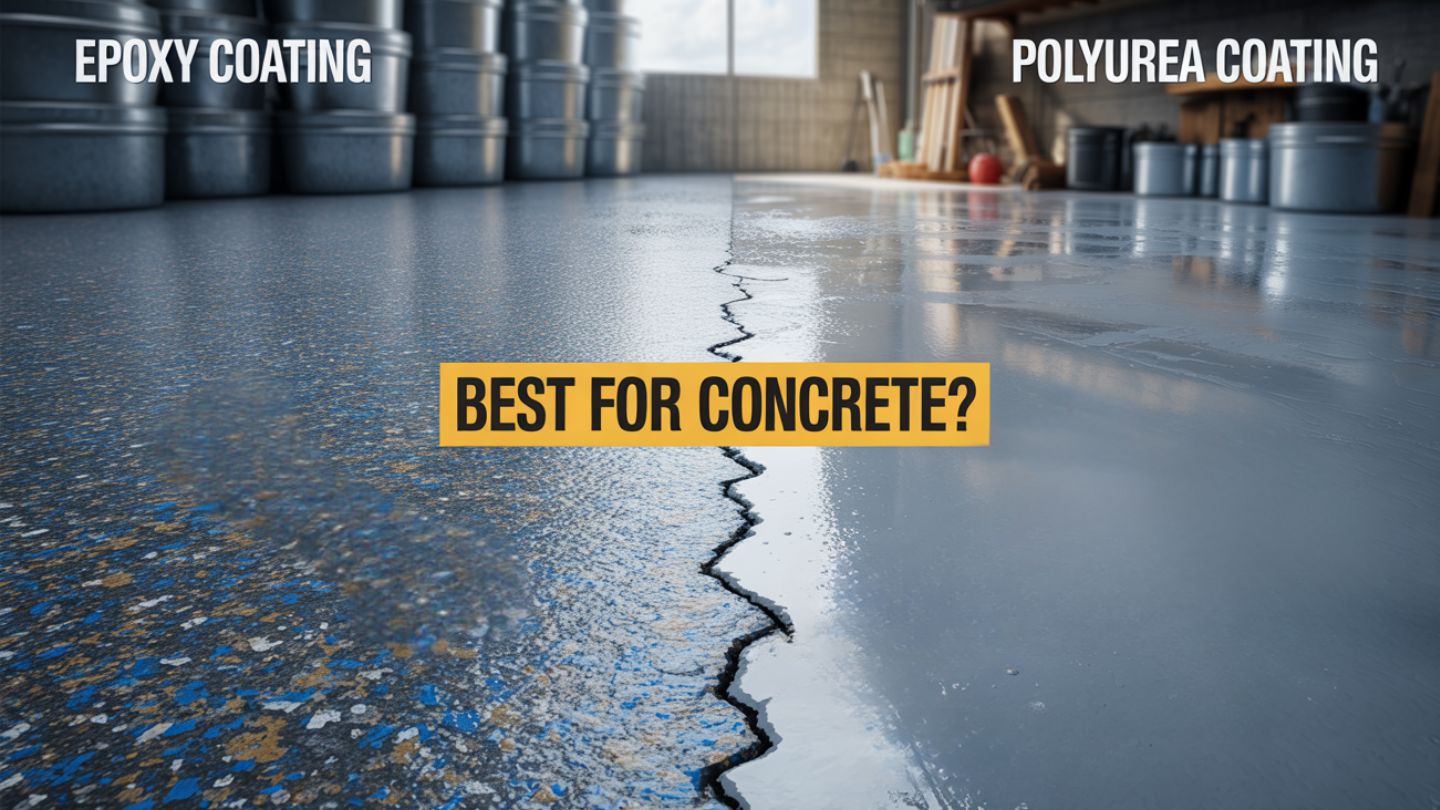
Epoxy is the coating type most homeowners start with because it is the most marketed and the most available at the consumer level. Standard two-part epoxy coatings provide a hard, chemical-resistant surface that performs well in controlled conditions. The significant limitation is UV sensitivity. Standard epoxy will amber and yellow with UV exposure, which means it is appropriate for interior applications like garage floors but not for outdoor surfaces in a high-UV environment like Texas.
Water-based epoxy products, which are the most common DIY option, have lower solids content than solvent-based professional products, which translates to a thinner finished coating and lower long-term durability. The adhesion profile of water-based epoxy is also lower, particularly when applied to concrete that has not been properly profiled through diamond grinding rather than simple acid etching.
Professional-grade solvent-based epoxy systems with 100 percent solids content are a different product from what is available at the consumer level. They cure harder, bond more tenaciously, and last significantly longer. The preparation requirements are also more demanding, which is one of the reasons professional application delivers different results from DIY application.
Polyurea and Polyaspartic: The Performance Tier
Polyurea and polyaspartic coatings have become the professional standard for many garage floor and commercial concrete applications. They cure faster than epoxy, which allows same-day return to service for most applications. They are inherently UV-stable, which makes them suitable for covered outdoor applications. And they maintain flexibility after cure, which gives them better performance on concrete that experiences minor movement.
Polyaspartic is a subtype of polyurea specifically formulated for floor coating applications, with an open time that is more workable for broadcast chip systems and other decorative configurations. Full-broadcast polyaspartic systems have become the dominant choice for garage floor coatings in the professional market, combining the durability of polyurea with the decorative flexibility that homeowners want.
The limitation of polyaspartic systems is sensitivity to moisture during application. High humidity or a concrete substrate with elevated moisture content can cause adhesion failure or surface defects. In a Texas summer, this is a real operational consideration that affects scheduling and preparation requirements.
Decorative Overlays: A Different Category
Decorative overlays are distinct from thin-film coating systems. Rather than a protective coating applied over existing concrete, a decorative overlay is a cement-based or polymer-modified material applied in a thicker layer to create texture, pattern, and a completely new surface aesthetic. This is the category that allows concrete to look like stone, tile, brick, or custom patterns.
The performance profile of a decorative overlay is different from a thin coating. A properly bonded and sealed overlay adds meaningful thickness to the surface, which contributes to durability and provides more material to work with in terms of surface texture and pattern customization. The aesthetic range is far broader than any thin-film coating system.
Overlay systems require a structurally sound base, thorough surface preparation, and skilled application. The hand-crafted nature of custom overlay work, where artisans cut, texture, and shade the material to create a custom finish, means the quality of the result is directly tied to the skill of the people doing the work.
Surface Preparation Is the Deciding Factor
In every category of concrete coating, the factor that most determines long-term performance is surface preparation. Concrete must be mechanically profiled to provide a surface that the coating can bond to. This means diamond grinding in most professional applications, which opens the pores of the concrete surface and creates a profile for mechanical adhesion.
The concrete must also be tested for moisture vapor emission before coating. Moisture transmitting through a concrete slab creates hydrostatic pressure that pushes applied coatings away from the surface, causing delamination that looks like bubbling or peeling. This failure mode is entirely predictable and entirely preventable with proper pre-installation testing and the right primer selection.
Skipped or inadequate surface preparation is the most common cause of coating failure, and it is almost always a consequence of cost-cutting or time pressure rather than ignorance. A coating applied over improperly prepared concrete will eventually fail regardless of product quality.
Maintenance and Resealing
All concrete coating systems require periodic maintenance to maintain their performance and appearance. The resealing frequency depends on the traffic level, the UV exposure, and the type of system applied. A properly maintained coating can last many years. An unmaintained coating will degrade from the surface down, losing its protective function gradually.
The maintenance conversation should happen before installation, not after. Understanding what you are committing to in terms of ongoing care helps you select a system that matches your maintenance willingness. A low-maintenance system that requires resealing every three to five years is a realistic commitment for most homeowners. A system that requires annual maintenance is appropriate for high-traffic commercial applications but may be more intensive than a residential homeowner wants to manage.